Go Outdoor
Inflatable Camping Tent Review: Features, Specs, and Basecamp Utility


Updated · Research-based review – how we review
Disclosure: As an Amazon Associate, GoOutdoor earns from qualifying purchases. If you buy through links on this page, we may earn a small commission at no extra cost to you. Learn more.



Inflatable Camping Tent Review: Fast Air-Beam Setup for Glamping and Basecamps
Traditional pole assemblies can make pitching large family shelters cumbersome. Inflatable air-beam architecture replaces rigid fiberglass and aluminum frames with high-pressure air columns for streamlined vehicle-based camping.
The Rise of Inflatable Air-Beam Architecture
Assembling a multi-person cabin tent often involves threading fragile poles through long fabric sleeves, securing pin-and-ring systems, and coordinating multiple people to lift a heavy framework. Inflatable camping tents simplify this routine by replacing interlocking metal or fiberglass frames with structural, high-pressure air beams. Instead of wrestling with split ferrules or bent aluminum sections, campers anchor the floor perimeter, connect a pump, and inflate the supportive structural columns in minutes.
This inflatable air glamping shelter caters to vehicle-supported outdoor travel, from family campsite setups to open-field tournament basecamps. Before investing in an air-beam structure, understanding the trade-offs in pack weight, wind resistance, and ventilation options is critical for choosing the right shelter on GoOutdoor.us.
📋 Who It’s For / Who Should Skip It
Who it’s for:
- Car campers, glampers, and family groups who want standing-height cabin space without assembling pole frameworks.
- Solo camp managers looking to pitch a multi-person basecamp shelter using an electric or manual air pump.
- Cooler-weather campers seeking built-in stove jack ports for four-season cabin comfort.
Who should skip it:
- Backpackers and weight-conscious paddlers needing compact, sub-10-pound shelters like the MSR Elixir 2.
- Primitive wilderness campers who lack vehicle cargo space to transport heavy Oxford canvas and pump equipment.
Key Architectural Features and Design Details
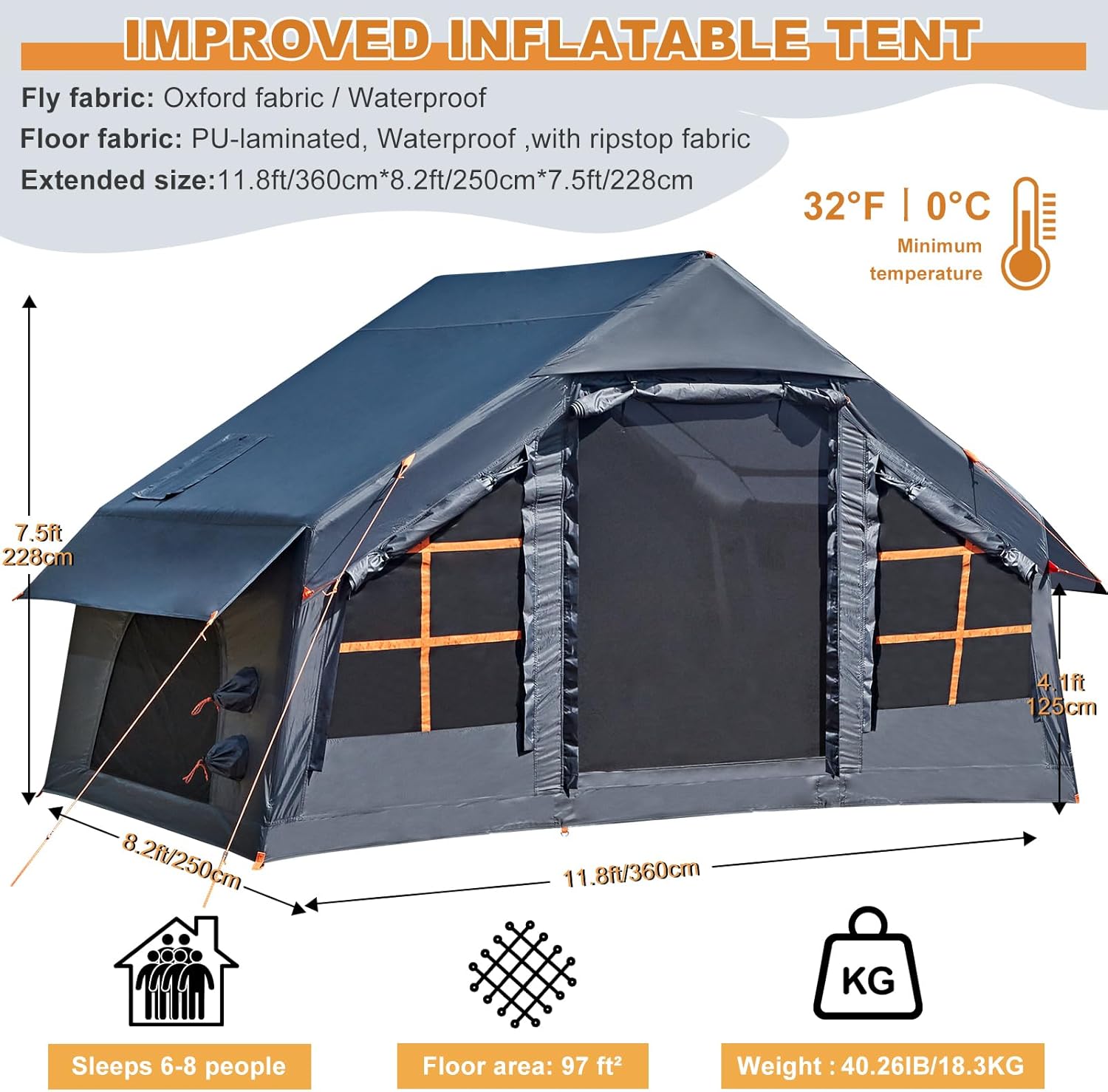
- Air-Beam Skeleton: High-pressure thermoplastic polyurethane (TPU) air columns replace standard poles, removing the risk of bent ferrules or fractured fiberglass segments.
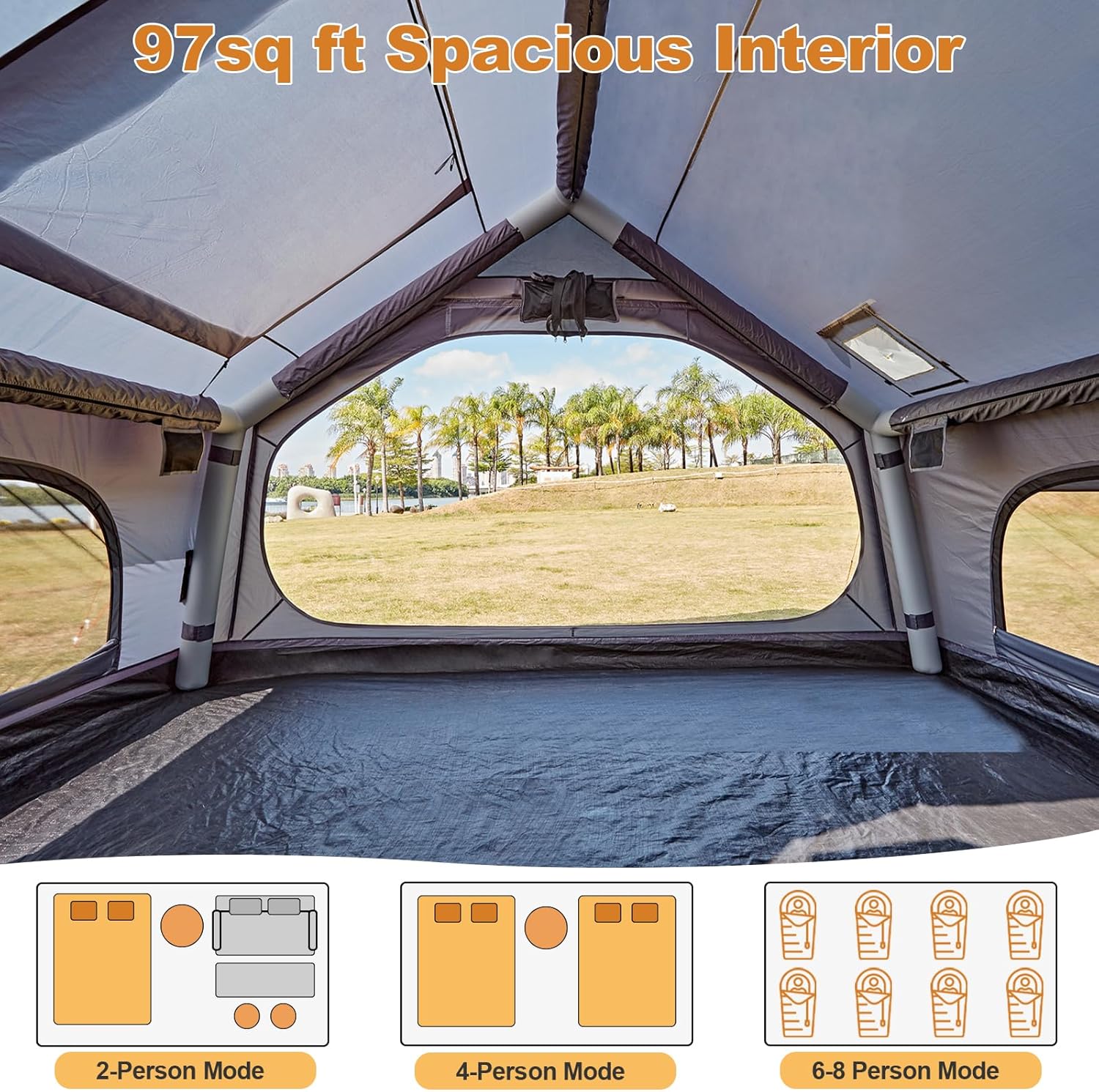
- Integrated Skylight and Large Windows: Transparent upper panels and wide screened openings introduce natural daylight, nighttime stargazing, and ambient cross-ventilation.
- Heavy-Density Oxford Exterior: High-density Oxford polyester fabric repels precipitation, protects against abrasion, and maintains structure across seasonal weather shifts.
- Stand-Up Livable Clearance: High vertical wall profiles and steep roof pitches allow adults to stand upright without crouching, maximizing usable floor space.
- Integrated Stove Jack Vent: Features a flame-retardant port designed to route wood stove piping safely during cold-weather outings.
Technical Specifications Overview
| Specification | Inflatable Glamping Tent Details |
|---|---|
| Setup Duration | Approx. 3 – 8 minutes (using an electric inflator) |
| Capacity Options | 2, 4, 6, and 8-person footprint variations |
| Canopy Textile | High-density waterproof Oxford cloth |
| Frame Construction | High-pressure TPU air beams |
| Climate Rating | 4-season design (includes integrated stove jack) |
Tent space planner: how many people really fit?
Person ratings usually assume sleepers lying shoulder to shoulder with no gear. Enter the floor size and the sleeping pads you actually use to see how the space works out.
Planning guide only: sloped walls reduce usable space near the edges, and pads must fit the floor's real shape. Measure your pads – sizes vary by brand.
Inflatable Glamping Tent vs. Lightweight Trekking Tents
Choosing between an inflatable basecamp palace and a traditional lightweight shelter comes down to packability versus interior volume. For large cabin comparisons, see our SENLEETO Inflatable Tent review.
| Criteria | Inflatable Glamping Shelter | Traditional Lightweight Trekker Tent |
|---|---|---|
| Interior Volume | ✅ Walk-in clearance / full standing headroom | ❌ Compact / sitting or sleeping profile only |
| Setup Process | ✅ Single-point air inflation (pump driven) | ❌ Manual shock-corded pole assembly |
| Packed Weight | ❌ Substantial / car-camping storage only | ✅ Minimal / fits inside or on a trail pack |
| Frame Resilience | ✅ Flexible air beams deflect wind without snapping | ❌ Thin poles can deform under severe side gusting |
Practical Basecamp Use Cases
Family Camping and Young Explorers
Managing young children while assembling a complicated pole network can be stressful. An inflatable shelter allows a single adult to peg out the four corners and pressurize the beams while unloading the vehicle. The heavy floor fabric tolerates active footwear, while vertical walls easily accommodate portable cots or stacked sleeping pads.
Sports Field Basecamps and Tailgating
Weekend sports tournaments, multi-day canine trials, and field meets require a weatherproof basecamp for staging gear, coolers, and folding camp chairs. An inflatable cabin offers protected standing shelter from driving rain or harsh mid-day sun without requiring permanent installation.
Pet-Friendly Travel Accommodations
Traveling with pets requires floor space that resists claw abrasion and eliminates exposed interior poles that can be tripped over or nudged out of alignment. Heavy Oxford canvas floor fabrics and smooth interior air-beam contours reduce snag points while providing reliable insulation from damp ground.
Field Tips for Inflatable Tent Longevity
- Site Preparation: Thoroughly inspect the ground and clear out sharp rocks, roots, and thorns before unfurling the tent. Using a dedicated ground tarp or footprint provides an extra layer of puncture defense.
- Monitor Air Pressure in Direct Sun: Ambient temperature changes cause air to expand and contract. Avoid over-inflating the beams on cool mornings if direct afternoon sun is anticipated, leaving adequate margin for thermal pressure expansion.
- Pair with a High-Volume Pump: While manual double-action hand pumps are dependable field fallbacks, a rechargeable 12V electric pump dramatically accelerates pitching and deflating routines.
Ordering Considerations and Availability
Choosing an air-beam shelter through Amazon provides access to multiple dimensional variants – ranging from compact two-person floor plans up to multi-room eight-person formats. Detailed user photographs clarify real-world cot spacing, mattress configurations, and carry-bag dimensions prior to departure.
Frequently Asked Questions
How do air-beam tents handle punctures in the field?
Inflatable shelters use durable internal TPU bladders enclosed within heavy polyester protective sleeves. In the event of a slow air leak, standard patch kits adhere directly to the TPU chamber to restore an airtight seal.
Does an inflatable tent overheat in warm weather?
Because high-density Oxford cloth is thick, airflow relies on mesh windows, roof vents, and panoramic skylights. Opening opposite windows allows cross-ventilation to vent heat during warm afternoon sun.
Can an inflatable cabin shelter be pitched by one person?
Yes. Because the shelter rises under pneumatic pressure rather than requiring someone to hold poles elevated while another stakes corner lines, one person can manage the entire pegging and inflation process independently.