Go Outdoor
AKNEAR Rechargeable LED Headlamp Review: Is This 99,000-Lumen Light Overkill?


Updated · Research-based review – how we review
Disclosure: As an Amazon Associate, GoOutdoor earns from qualifying purchases. If you buy through links on this page, we may earn a small commission at no extra cost to you. Learn more.


High-Output Illumination: What Does the AKNEAR Actually Deliver?
Standard compact headlamps are designed primarily for short-range task lighting – finding gear in a backpack, setting up a tent after sunset, or navigating a well-trodden trail. However, activities that demand long-distance beam throw, heavy rain resistance, or extended backup lighting during a prolonged blackout quickly expose the limits of basic lightweight torches.
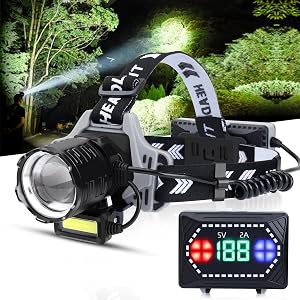
The AKNEAR Rechargeable LED Headlamp positions itself at the extreme end of personal lighting gear. Sporting an advertised 99,000 lumens peak output, a heavy-capacity battery system claiming runtimes ranging from 10 to 15 hours on high mode up to 25+ days in minimum-drain modes, and submersible IPX-7 water ingress protection, this unit prioritizes maximum forward projection and rugged weather resistance. Understanding whether that immense output profile fits your outdoor routine comes down to weight, beam geometry, and runtime demands.
Who It’s For / Who Should Skip It
Who it’s for:
- Campers, night hikers, and property owners who need long-distance spotlighting and adjustable beam focus.
- Work crews and DIYers who require hands-free lighting with downward tilt on a hard hat or work cap.
- Anyone building an emergency outage kit that values multi-day low-mode survival runtimes and built-in USB power output.
Who should skip it:
- Ultralight backpackers and trail runners seeking a featherweight, bounce-free forehead strip.
- Campers who primarily need diffuse, wide overhead area illumination across an entire camp space – an elevated system like the CAVN Rechargeable Camping Light on a tripod works better for shared social areas.
- Users who only need close-range task lighting inside a tent where extreme forward candela is unnecessary.
Main Features and Hardware Capabilities
- Advertised 99,000-Lumen Peak Output: Utilizes a high-output LED chip configured for long-range forward penetration, cutting deep through tree lines, open fields, and heavy mist.
- Multi-Day Runtime Profile: Supported by a high-capacity rechargeable battery pack that delivers up to 10 – 15 hours on high-output settings and stretches past 25 days on minimal output levels.
- 12 Dedicated Output Modes: Includes variable spotlight and floodlight steps, along with defensive strobe and emergency SOS signaling configurations.
- IPX-7 Waterproof Rating: Engineered beyond entry-level IPX-4 splash resistance to withstand immersion in water, making it dependable in torrential rain or stream crossings.
- Telescopic Zoom and 125° Tilt: The housing tilts through 125 degrees to align with ground-level footpaths, while the optic barrel slides to adjust from a wide peripheral pool to a concentrated spotlight.
AKNEAR Headlamp Technical Specifications
| Feature | AKNEAR Specification |
|---|---|
| Peak Output | 99,000 Lumens (Manufacturer Rating) |
| Battery Runtime | 25+ Days (Low Setting) / 10 – 15 Hours (High Setting) |
| Waterproofing | IPX-7 (Submersion Protected) |
| Lighting Configurations | 12 Modes (Spot, Flood, Strobe, SOS) |
| Beam Adjustment | 125° Articulating Tilt + Telescopic Optical Zoom |
| Charging System | USB Rechargeable (5 – 8 Hour Full Cycle) with Power-Bank Function |
AKNEAR Headlamp vs. Wide-Beam Alternatives
Selecting the right outdoor headlamp depends directly on how light must be dispersed across your field of view. The Smiling Shark Triple Strip Headlamp emphasizes a wide 230-degree panoramic flood for close-range tasks, whereas the AKNEAR focuses on forward beam throw, raw intensity, and submersion-level weatherproofing.
| Specification / Feature | AKNEAR Headlamp | Smiling Shark Triple Strip |
|---|---|---|
| Beam Profile | Telescopic Spot & Forward Focus | 230° Wide Panoramic Flood |
| Water Ingress Protection | IPX-7 Submersible | IPX-4 Splash-Proof |
| Advertised Output | 99,000 Lumens (Peak Spec) | High-Output Strip Array |
| Focus Adjustment | Yes (Telescopic Zoom) | No (Fixed Flood) |
| Primary Application | Distance Search & Route Scouting | Camp Cooking & Workbench Repair |
Decision takeaway: If you need to identify trail markers, scan distant perimeters, or cut through dark woods, the AKNEAR’s concentrated beam is the better tool. For cooking at a camp table or sorting gear in tight quarters, a broad strip lamp provides softer perimeter lighting without a harsh center hotspot.
Operating Tips for High-Output Headlamps
- Reserve High Output for Distance: Use the lowest effective setting for close-up reading, cooking, or tent organization. Firing peak output at close, reflective surfaces will degrade night vision.
- Use the Zoom Ring Strategically: Slide the telescopic barrel outward into a wider flood setting when walking technical terrain to track rocks and tree roots in your peripheral path.
- Dial In the Headstrap Tension: Because large-capacity battery packs add noticeable mass compared to minimalist torches, adjust both the side and overhead straps firmly against your skull or hard hat to eliminate bounce.
- Plan Charging Time: Recharging a large power cell takes roughly 5 to 8 hours over USB-C, so plug it in well before departure rather than expecting a quick 30-minute top-off.
Check Current Availability and Pricing
Equipped with multi-mode beam control, an IPX-7 waterproof housing, and extended battery runtimes, the AKNEAR is engineered for demanding conditions.
Frequently Asked Questions
Is the AKNEAR headlamp suitable for trail running?
The AKNEAR is built with a substantial battery pack and a heavy-duty optic head, making it noticeably heavier than minimalist headband strips. While functional for walking or steady jogging when properly tightened, it is bulkier than dedicated ultralight running headlamps.
Can the AKNEAR function as a power bank?
Yes. Models equipped with an integrated USB-out port allow you to tap the internal battery to provide emergency power to smaller electronics like a smartphone.
How long does it take to fully charge the headlamp?
Due to the high-capacity battery cell required to support 10 – 15 hours of high output, a complete recharge typically takes 5 to 8 hours using a standard USB-C connection.
What is the benefit of an IPX-7 rating over IPX-4?
IPX-4 certifies equipment only against light water splashes from any direction. IPX-7 indicates protection against continuous heavy rainfall and temporary submersion in water, preventing internal circuit failure if dropped into puddles or shallow streams.